EN
Rapid Response After Heavy Snowfall
Rapid Response After Heavy Snowfall
Jan 29, 2026
In recent days, heavy snowfall has affected multiple regions, with prolonged snow and low temperatures causing ice accumulation on power lines, fallen trees pressing on conductors, and damage to electricity infrastructure in some areas.
During the most intense phase of the snowfall, insulated bucket trucks were temporarily held back to ensure operational safety, while power utilities focused on monitoring, fault assessment, and emergency standby.
As snowfall gradually subsided and road conditions began to improve, power grid restoration work quickly entered an accelerated phase. Insulated bucket trucks were among the first specialized equipment deployed for post-snowfall power repairs.
Restoration Work Accelerates After Snowfall Ends
During heavy snowfall, slippery roads, low visibility, and severe icing on overhead lines significantly increase the risks associated with live-line operations. Power utilities in multiple regions indicated that during continuous snowfall, repair activities primarily centered on fault identification, remote monitoring, and personnel standby, in order to prevent secondary safety incidents.
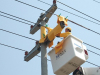
Once snowfall ended and weather conditions improved, insulated bucket trucks were rapidly mobilized, becoming a key piece of equipment in post-snowstorm power grid restoration. Repair crews used these vehicles to access damaged line sections and carry out focused operations, including removing ice-covered conductors, repairing broken strands, and clearing tree obstructions.
Insulated Operations Improve Restoration Efficiency
In the early stage after snowfall, some power lines remained energized or partially energized, making traditional pole-climbing methods both risky and inefficient.
Our 4x2-26m-Insulated Bucket Truck features an electromagnetic power take-off with a direct connection to the gearbox, providing efficient power transfer to support operations. The work platform measures 1000x700x1000(mm) is made from fiberglass, designed to hold two people and withstand pressures up to 35/46 kV.
It's equipped with a multi-function three-axis handle for complete directional control, enabling movement in all directions, including upper and lower arm adjustments, extension and retraction, and platform rotation. Additional safety features include a hydraulic ±100° rotation capability, vertical dumping, and an emergency stop, with a rated load capacity of 320 kg.
Using insulated booms, crews can accurately approach fault locations to remove ice, repair line connectors, and replace damaged components, significantly reducing repair time at individual sites.
In residential areas and along major urban power corridors, the deployment of insulated bucket trucks has helped avoid prolonged power outages, supporting daily life and essential urban operations.
.webp)
Upgrading Equipment and Response Mechanisms for Extreme Weather
As extreme weather events become more frequent, power grid operators face increasing demands for specialized equipment and structured emergency response capabilities.
Insulated bucket trucks have become an indispensable part of winter power grid maintenance systems, playing a key role in the overall strategy of “risk control during snowstorms and rapid power restoration after snowfall.”
Power utilities state that they will continue to improve emergency response plans, strengthen reserves of insulated aerial equipment, and enhance personnel training, in order to better address future extreme weather events and ensure the safe and stable operation of power grids.
.webp)

Recent Posts

October 26, 2016
The Most Successful Engineering Contractor

.webp?x-oss-process=image/resize,w_100/quality,q_100)
Jan 29, 2026
How Are Thousands of Lights Safely Maintained

Contact Us
Product Information
Quantity
Unit
Piece
Support order samples, customization, wholesale direct, and complete payment. If the product you look for does not have corresponding customized content, pls fill out the form below to contact us, and we will reply ASAP.